For many business leaders, Digital Transformation and Artificial Intelligence have become impossible to ignore.
Every conference talks about it. Every technology vendor sells it. Every business publication writes about it.
Yet despite all the attention, many organizations still struggle to answer one simple question:
What does Digital & AI Transformation actually mean for my business?
The answer is much simpler than most people think.
Digital & AI Transformation is not about buying the latest software. It is not about implementing AI because everyone else is doing it. And it is certainly not about replacing people with machines.
At its core, Digital & AI Transformation is about making a business work better.
It is about improving visibility, increasing efficiency, enabling better decisions, creating better customer experiences, and helping leadership gain greater control over the business.
The technology itself is only a tool.
The real objective is business improvement.
The Real Challenge
Most businesses already have technology.
They have websites, CRMs, ERPs, accounting systems, marketing platforms, dashboards, and communication tools.
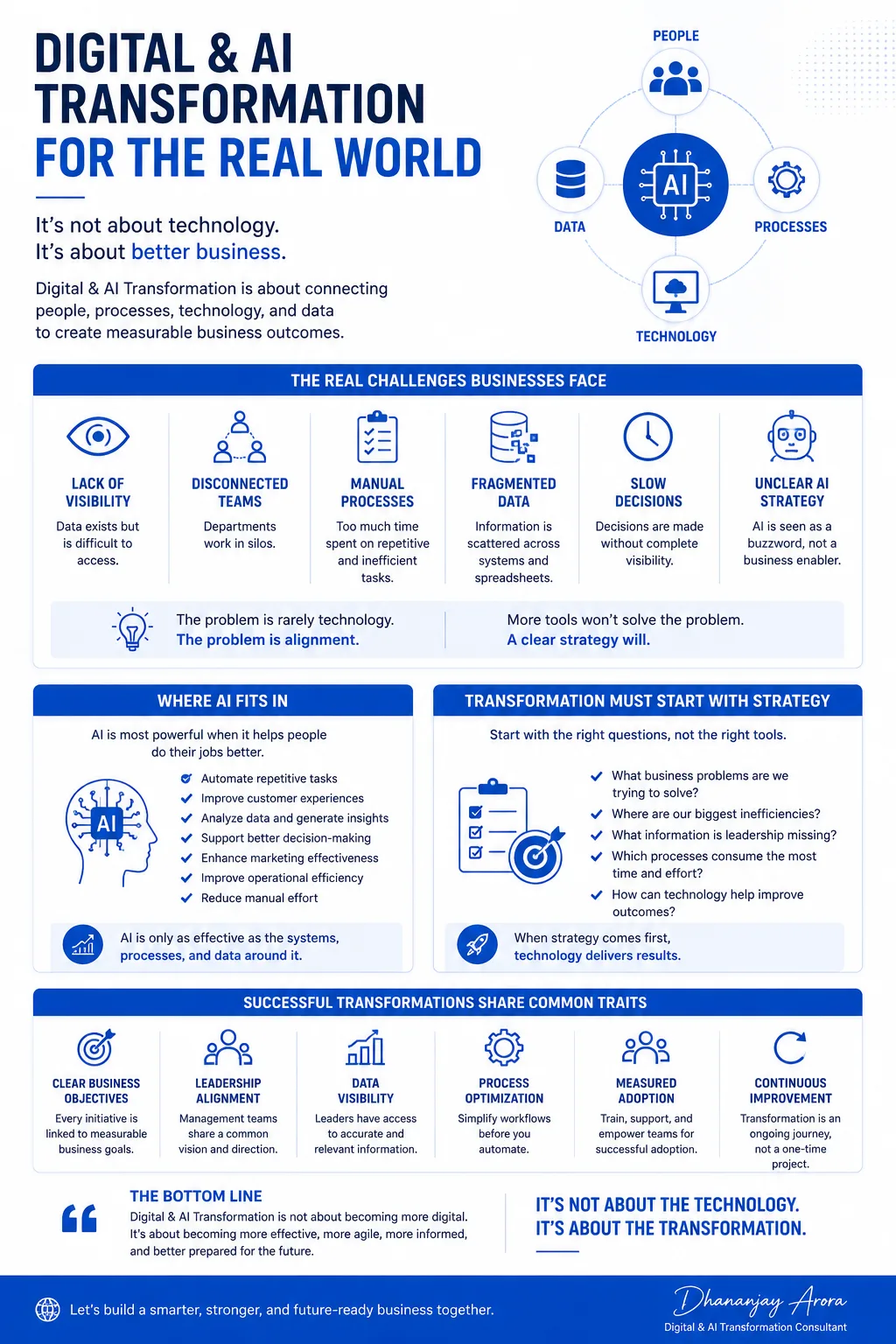
Yet many still face common challenges:
- Data exists but is difficult to access.
- Teams work in silos.
- Decisions are made without complete visibility.
- Marketing and sales operate independently.
- Processes rely heavily on manual intervention.
- Leadership lacks a single view of business performance.
Adding more software rarely solves these problems.
In many cases, it simply adds another layer of complexity.
The challenge is not the lack of technology.
The challenge is connecting people, processes, data, and technology in a way that supports business goals.
Where AI Fits In
Artificial Intelligence is often viewed as a magic solution.
It isn't.
AI is most valuable when it helps people perform their jobs better, faster, and more accurately.
In the real world, AI can help businesses:
- Automate repetitive tasks.
- Improve customer support.
- Analyze large volumes of data.
- Generate insights for decision-making.
- Enhance marketing effectiveness.
- Improve operational efficiency.
- Reduce manual effort across departments.
However, AI is only as effective as the systems and processes around it.
If business data is fragmented, processes are unclear, and teams are disconnected, AI will only amplify those existing challenges.
Successful AI adoption begins with business readiness.
Transformation Must Start with Strategy
One of the biggest mistakes organizations make is starting with technology instead of strategy.
The better approach is to begin with questions such as:
- What business problems are we trying to solve?
- Where are our biggest inefficiencies?
- What information is leadership missing?
- Which processes consume the most time and effort?
- How can technology help improve outcomes?
Once these questions are answered, technology becomes easier to evaluate and implement.
The focus shifts from tools to results.
The Most Successful Transformations Share Common Traits
Businesses that achieve meaningful transformation typically focus on a few key principles:
Clear Business Objectives
Technology initiatives are linked directly to measurable business goals.
Leadership Alignment
Management teams share a common vision and direction.
Data Visibility
Decision-makers have access to accurate and relevant information.
Process Optimization
Existing workflows are simplified before automation is introduced.
Measured Adoption
Teams are trained and supported to ensure successful implementation.
Continuous Improvement
Transformation is viewed as an ongoing journey rather than a one-time project.
The Bottom Line
Digital & AI Transformation is not a technology project.
It is a business transformation initiative powered by technology.
The organizations that succeed are not necessarily those with the biggest budgets or the newest tools.
They are the ones that focus on solving real business problems, improving operational efficiency, and creating a clear roadmap for change.
In the end, transformation is not about becoming more digital.
It is about becoming more effective, more agile, more informed, and better prepared for the future.
That is what Digital & AI Transformation looks like in the real world.
Author - Dhananjay Arora (Digital & AI Transformation Consultant helping businesses align strategy, technology, data, and AI for measurable business outcomes.)