How ₹50 Cr+ Businesses Can Structure Their Journey from AI Curiosity to AI-Led Growth
Every business leader I speak to these days has the same question: 'Where do we even start with AI?'
And honestly, its the right question to be asking. The problem is it usually comes up a bit too late, after a tool has already been bought, an agency has been brought in, and three months have gone by with very little to show for it.
The issue isn't AI. Its the absence of any structured thinking before AI enters the picture.
In this article I want to share a sample AI Transformation Roadmap, the kind I build with leadership teams of ₹50 Cr+ businesses before any technology decision gets made. Its not a rigid template because every business is different. But the structure, the sequencing, the thinking behind it, that part is fairly universal.
AI transformation is not a technology project. It is a business transformation project that uses technology as its primary tool.
Why Most AI Initiatives Fail and Why a Roadmap Changes That
Over the last couple of years I've seen a pretty consistent pattern in how Indian businesses approach AI, particularly at the ₹50 Cr to ₹500 Cr level:
- The MD reads something, or comes back from a conference energised about AI.
- A decision gets made to 'implement AI' without really defining what problem it actually needs to solve.
- A vendor is brought in. Tools get purchased. A pilot kicks off.
- Six months later the tools are barely being used, the team is confused, and leadership is frustrated with the whole thing.
This isn't a technology failure. Its a planning failure. Almost always.
A structured AI Transformation Roadmap fixes this by getting three things answered before any tool gets selected:
- What specific business problem are we actually trying to solve?
- Is our data, our processes, and our team ready for AI right now?
- What does success look like and how will we measure it?
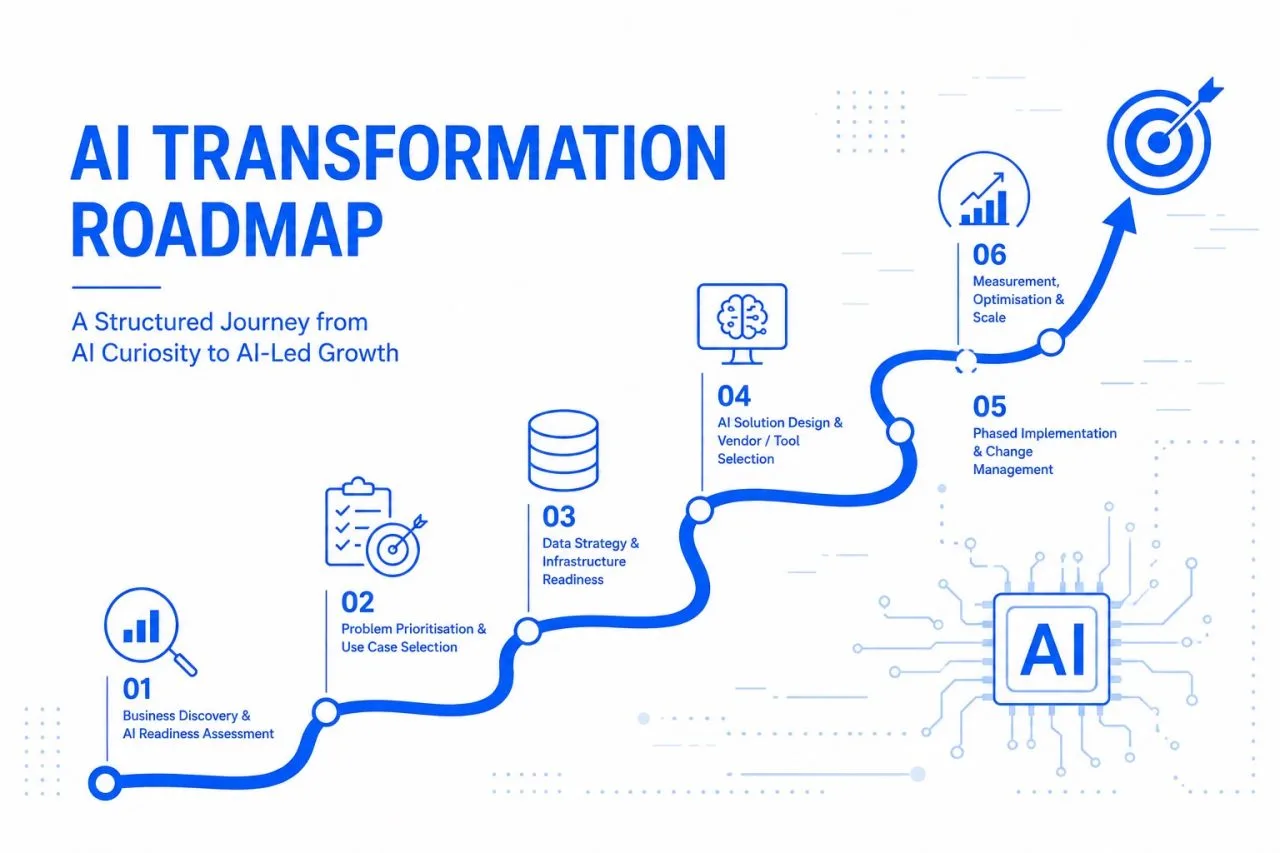
The AI Transformation Roadmap: 6 Stages
What follows is a sample roadmap built around a mid-sized Indian business, say ₹100 to 500 Cr in annual revenue, 200 to 500 people, multiple operating departments. The names are illustrative but the logic is real.
Before we talk about any AI tool, we map the business. Properly.
Key Actions:
- Speak to leadership across key departments: Sales, Operations, Finance, Marketing, HR
- Map the existing technology stack, data sources, and where systems connect to each other (or don't)
- Find the manual, repetitive or high-cost processes that are good candiates for automation
- Assess data quality, availability, and how well its currently being governed
- Score AI readiness across 5 dimensions: Data, Process, People, Technology, Leadership
Outcome: A clear, honest picture of where AI can genuinely add value in this business and where the groundwork still needs work.
We don't go after every AI opportunity at once. We pick the right ones first.
Key Actions:
- List every potential AI use case that came up during Stage 01
- Score each use case on four things: Business Impact, Feasibility, Data Availability, Time-to-Value
- Narrow down to the top 3 to 5 use cases for Phase 1
- Define what success looks like for each one, in measurable KPIs not vague goals
- Get alignment and sign-off from leadership before moving forward
Outcome: A focused, prioritised list of AI opportunities with solid business justification behind each one, not just technology enthusiasm.
AI is only as useful as the data behind it. This stage makes sure the foundation is actually solid.
Key Actions:
- Audit all existing data: sources, formats, quality issues and gaps
- Define a data collection and enrichment strategy specific to the selected use cases
- Set up data governance: who owns what, who can access what, and how its maintained
- Identify what integrations are needed between existing systems like CRM, ERP, custom tools
- Build or configure the data pipelines that the AI solutions will rely on
Outcome: A data infrastructure thats genuinely AI-ready: structured, clean, accessible, and with someone accountable for keeping it that way.
Now, and only now, we choose the right tools and solutions.
Key Actions:
- Decide build vs. buy vs. configure for each use case based on what we've learned so far
- Evaluate and shortlist AI vendors, platforms or tools that fit the actual requirements
- Design the solution architecture for each AI use case
- Map out how each solution integrates with the existing technology stack
- Run a proof of concept for the highest-priority use case before commiting to a full rollout
Outcome: A validated solution design that reflects the right choices for this business, not whatever happens to be trending at the moment.
Execution with full accountability. Equal attention on people as on the technology.
Key Actions:
- Roll out AI solutions in phases, starting with the use case that has the clearest business value
- Run parallel operations during the transition so we can validate AI outputs against real results
- Train department heads and frontline users on the new workflows
- Put escalation protocols in place for when AI outputs are wrong or unclear
- Communicate what's changing to the broader team and manage the resistance that will come up
Outcome: AI solutions running in production, teams who actually know how to use them, and early adoption data to guide what gets refined next.
Transformation doesn't end at go-live. This stage is what makes it compound over time.
Key Actions:
- Track the KPIs defined in Stage 02: measure what actually happened vs. what was projected
- Run monthly reviews with leadership to course-correct where needed
- Find optimisation opportunities in the AI solutions that are already live
- Expand what's working to other departments, business units or geographies
- Start identifying the next wave of use cases for Phase 2
Outcome: A continuously improving AI setup, with measurable ROI and a clear picture of what comes next.
Sample Transformation Timeline
For a ₹100 to 500 Cr business starting from scratch, here's a realistic picture of how the first 12 months can look:
| Phase | Timeline | Focus Areas | Expected Outcomes |
|---|---|---|---|
| Phase 1 | Month 1 to 2 | Discovery, Readiness Assessment, Use Case Prioritisation | Transformation Roadmap document, AI Readiness Score, top 3 use cases agreed and signed off |
| Phase 2 | Month 2 to 4 | Data Strategy, Infrastructure prep, Solution Design | Clean data pipelines in place, vendor shortlist finalised, solution architecture approved by leadership |
| Phase 3 | Month 4 to 8 | Implementation of Priority Use Cases | 2 to 3 AI solutions live in production, teams trained, early KPI data starting to come in |
| Phase 4 | Month 8 to 12 | Measurement, Optimisation, Phase 2 Planning | ROI validated against targets, live solutions optimised, Phase 2 roadmap drafted and ready |
What This Actually Looks Like in Practice
Three examples from my own consulting work, all anonymised but very real:
Manufacturing Conglomerate (₹45,000 Cr revenue)
The challenge: Multiple business verticals, a strong offline reputation, and almost no digital visibility. Technology, marketing and data were all operating independently with no shared roadmap at all.
What we focused on: Aligning the digital ecosystem, building an SEO and content strategy, creating a lead generation architecture, and setting up cross-vertical reporting dashboards that leadership could actually use day to day.
What happened in 6 months: 10X growth in search impressions. 4X increase in inbound leads.
Infrastructure & Highway Construction Company
The challenge: Tender discovery was entirely manual. Teams were spending weeks qualifying and responding to opportunities, with a fairly low hit rate.
What we built: An AI-powered tender intelligence platform that automated discovery, relevance scoring, pre-qualification analysis, and the first draft of tender responses.
The result: 10X reduction in manual effort. Significantly more tenders participated in, with better quality responses going out the door.
Exhibition & Events Company
The challenge: Sales team performance was basically invisible to leadership. Lead allocation happened on gut feel. Revenue forecasting was, to be honest, mostly guesswork.
What we built: An AI-enabled CRM with sales intelligence built in, lead scoring, smart allocation rules, performance dashboards and a revenue forecasting model.
The result: Full visibility for leadership across the sales function. Measurable improvement in conversion and team accountability. The whole thing went live in 30 days.
So, Where Do You Start?
If you're running a ₹50 Cr+ business and genuinely asking 'where do we start with AI?', the answer isn't a tool. Its not a vendor. Its not a workshop.
Its a structured conversation. A diagnostic. A roadmap built around your actual business problems, not a template borrowed from someone else's case study.
The businesses that lead their industries 5 years from now won't be the ones that moved fastest on AI. They'll be the ones that moved smartest.
I've built a free Digital Readiness Scorecard that gives you a quick read on where your business stands across five transformation dimensions. Takes about 5 minutes.
You can take it at: dhananjayarora.com/scorecard
And if you're ready to have a more direct conversation about what a transformation roadmap might look like for your business, book a consultation at dhananjayarora.com.