The Real Reason AI Investments Go Wrong
Most AI projects fail not because of bad technology, but because of what happens (or doesn’t happen) before the technology is even selected.
Let me say something upfront that doesn’t get said enough in the AI conversation:
The technology is rarely the problem.
In 25 years of working with businesses across India, from early-stage companies to ₹45,000 Cr conglomerates, I’ve seen organisations put serious money into AI, automation, digital transformation, and walk away with very little to show for it. Not because the tools were wrong. Because the thinking that led to those tools was wrong.
No discovery. No problem mapping. No roadmap. Just a vendor, a budget, and a lot of optimism.
What I’ve built over the years, and what I use in every consulting engagement I run, is an 8-stage model that makes sure we never walk into a technology decision without a clear, accountable foundation underneath it. This article walks through each stage and explains why skipping even one of them tends to be quite costly.
Every rupee wasted on AI can usually be traced back to a decision made before the AI was selected. The 8-stage model is designed to prevent exactly that.
The Real Reason AI Investments Go Wrong
I’ve had this conversation more times than I can count. A founder or MD calls me in after an AI project hasn’t delivered what it was supposed to. The team is demoralised. The board has gone quiet on the subject. And there’s usually a vendor somewhere in the picture with a very confident explanation of why things didn’t work out.
When I dig in, the story is almost always the same. The business skipped the front-end thinking. They jumped straight to solutions before they’d properly understood the problem. They bought tools before checking whether their data could actually support those tools. They ran pilots without agreeing on what success was supposed to look like.
The result? Technology that works perfectly fine, but solves the wrong problem, in a business that wasn’t ready for it anyway.
The 8-stage model exists to close that gap. Its not a consulting framework built for its own sake. Its the difference between an AI investment that delivers a measurable return and one that becomes a budget line nobody wants to talk about.
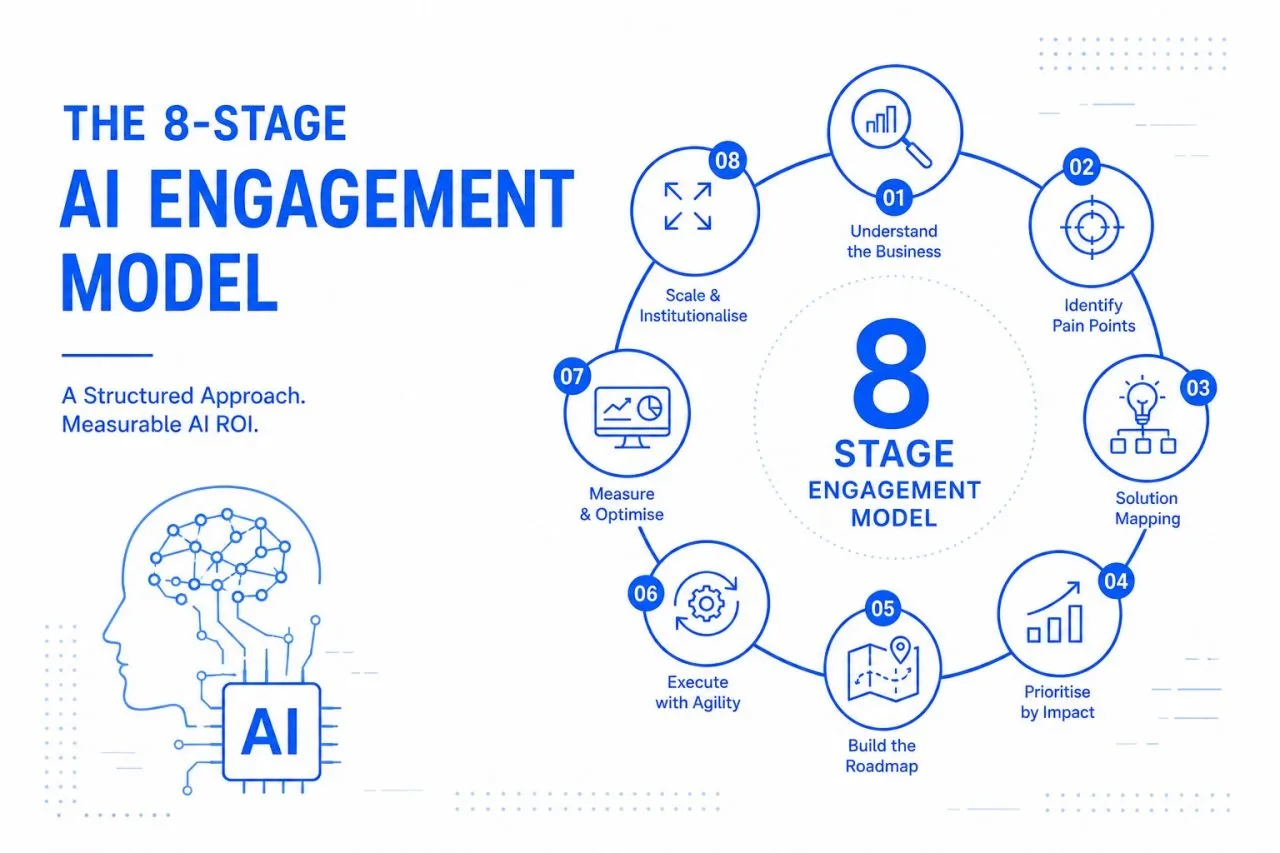
The 8-Stage Engagement Model
Here’s how every engagement I run is structured, and why each stage matters just as much as the one before it.
Understand the Business
You can’t transform what you don’t properly understand.
This sounds obvious. It isn’t. Most consultants and vendors spend a few hours in a discovery call, skim the surface of what the business does, and move straight to recommending solutions. That’s not discovery. That’s a sales pitch with a nicer name.
Real business understanding takes time. It means speaking to leadership across functions, not just the person who hired you. It means understanding the business model, the revenue drivers, the cost pressures, how decisions get made, and where the real authority sits in the organisation. Only when you have that full picture should you even think about recommending anything.
Identify Pain Points
Map the pain across every stage of the business, not just the parts that are loudest.
There’s always a stated problem and a real problem. The MD says the leads aren’t converting. The real problem is the CRM hasn’t been updated in four months, the sales team is working off two different spreadsheets, and marketing has zero visibility into what happens after a lead is handed over.
Stage 2 is about mapping pain points methodically, across every operational stage, every department, every handoff in the business. We’re not just listening for what people complain about loudly. We’re looking for where the business is quietly losing time, money, and opportunity, even in places where nobody’s raised their hand yet.
Solution Mapping
Match the right technology to each problem, with time and cost attached to every option.
This is where technology finally enters the conversation. Not before. Once we have a clear picture of the business and its pain points, we can start mapping potential solutions against each problem. AI tools, automation workflows, platform changes, process redesigns, whatever fits best.
The important thing here is that every solution gets mapped with a realistic time estimate and a cost range. This isn’t a wishlist or a vendor brochure. It’s a structured menu of options that the business can evaluate on its own merits. No hidden costs, no vague ‘it depends’ answers. Just a clear view of what’s available and what each option actually involves.
Prioritise by Impact
Not every problem deserves to be solved first. Choose with your head, not your enthusiasm.
After Stage 3, there’s usually a fairly long list of things that could be done. The temptation, especially in leadership teams that are genuinely excited about transformation, is to try and tackle everything at once. That’s a reliable way to ensure nothing gets done properly.
Stage 4 is about cutting through that. We score every potential initiative on two things: business impact and implementation feasbility. High impact, high feasibility goes first. We build the sequence from there. This step alone has saved clients a significant amount of money, simply by stopping them from investing in complex initiatives before the simpler, higher-impact ones are even in place.
Build the Roadmap
A phased, structured plan that the whole leadership team can read, understand and actually hold to.
The roadmap is the output of everything that’s come before it. It’s not a slide deck. It’s a working document, phased by quarter, tied to business outcomes, with clear owners, budgets and dependencies all mapped out.
A good transformation roadmap should be something a non-technical MD can read and immediately understand. What are we doing, in what order, why that order, what does each phase cost, and what should it deliver? If the answer to any of those questions isn’t clear, the roadmap isn’t finished yet.
Set Milestones
Quarterly goals. Review frameworks. No ambiguity about what success looks like at each stage.
One of the most common failure modes in transformation projects is that nobody defined what done actually looks like along the way. Six months in, everyone has a different version of whether things are on track. The vendor thinks yes. The internal team isn’t sure. Leadership is waiting for a number that nobody ever agreed to measure.
Stage 6 closes that gap. We set specific, measurable milestones for each phase of the roadmap and build a review framework that makes it straightforward to check progress at the end of every quarter. Not just is the technology live, but is it delivering what we said it would, by when we said it would.
Drive Execution
End-to-end accountability. Not advice from a distance.
Most consultants hand over a strategy document and move on. That’s not how I work. Stage 7 is about being present in the execution, working alongside the internal team, managing vendors, clearing blockers as they come up, and making sure the roadmap actually gets implemented rather than gathering dust on a shelf.
Execution is where transformation either happens or it doesn’t. Technology projects run into unexpected issues. Teams push back on change. Vendors overpromise. None of that is unusual and none of it is unsurmountable, but it does require someone in the room who’s accountable for keeping things moving and has enough context to make sensible decisions when the plan needs to shift.
Measure Results
Deliver against the KPIs we defined together. Then work out what comes next.
The engagement doesn’t end at go-live. It ends when we’ve measured actual outcomes against the targets we agreed back in Stage 6, and when the business has a clear picture of what the investment actually delivered.
Stage 8 is also where the next cycle starts. What worked well? What didn’t, and why? What do we now know about the business that we didn’t know when we began? That knowledge feeds directly into the next phase of the roadmap and its how transformation becomes an ongoing capability rather than a one-off project.
Why the Order Matters as Much as the Stages Themselves
I want to be straight about something. Each of these eight stages is necessary on its own. But what makes the model actually work isn’t just the individual stages, its the sequence.
You can’t do Stage 3 (solution mapping) properly if you haven’t done Stage 2 (pain point identification). You can’t do Stage 5 (build the roadmap) without Stage 4 (prioritise by impact). And you absolutely can’t do Stage 7 (execution) without Stage 6 (milestones), because without milestones, nobody can honestly say whether the execution is working or not.
Every shortcut I’ve seen businesses take in this sequence has cost them, usually more than whatever the shortcut was supposed to save. The model isn’t about being slow. A full 8-stage engagement can move quickly when the business is ready and engaged. But it doesn’t skip steps.
The question isn’t whether you can afford to follow an 8-stage process. Its whether you can afford what happens when you don’t.
What It Looks Like in a Real Engagement
To give you a sense of how this plays out in practice, here’s a rough timeline for a typical engagement with a ₹100 to 500 Cr business:
| Stages | Typical Duration | Primary Output |
|---|---|---|
| 01 + 02: Understand & Identify | 2 to 3 weeks | Business overview document, pain point map across all departments |
| 03 + 04: Map & Prioritise | 1 to 2 weeks | Solution options with cost and time estimates, prioritised initiative list |
| 05 + 06: Roadmap & Milestones | 1 to 2 weeks | Full transformation roadmap, quarterly milestone framework, KPI definitions |
| 07: Execution | 3 to 12 months | Live implementations, vendor management, team training, progress reviews |
| 08: Measure | Ongoing | KPI reports, ROI documentation, Phase 2 roadmap |
A Quick Note on Speed
I know what some people are thinking when they read this: sounds thorough, but does it really have to take this long?
Honestly, the front-end stages, 01 through 06, typically take about 4 to 6 weeks for a business that’s engaged and moving at a reasonable pace. That’s not a long time. What takes a long time is spending 6 months on an AI implementation that delivers nothing, then 3 more months trying to understand why, and then starting the whole thing over again.
The businesses I’ve worked with that moved fastest through transformation were without exception the ones who invested properly in the upfront thinking. Because once the roadmap is solid, execution is genuinely fast. No backtracking, no 'we should have thought about this earlier', no emergency calls because something important wasn’t considered. Just clear priorities, clear owners, and clear milestones.
That’s what the 8-stage model is built to create.
If You’re Thinking About AI for Your Business
Whether you’re right at the beginning of this journey or you’ve already tried something that didn’t quite land the way you hoped, the starting point is the same. A structured understanding of your business, your problems, and what you’re genuinely trying to achieve.
Not a vendor demo. Not a pilot. A proper diagnostic first.
The 8 stages aren’t a process I built to make engagements longer. They’re the minimum viable thinking required to make AI actually work in a real business.
I’ve put together a free Digital Readiness Scorecard that gives you a quick honest read on where your business stands before any of this begins. It covers data maturity, process readiness, technology alignment, leadership clarity and team capability, the five things that tend to make or break an AI initiative.
Take it at: dhananjayarora.com/scorecard
And if you want to have a direct conversation about what an 8-stage engagement might look like for your specific business, you can book a consultation at dhananjayarora.com.