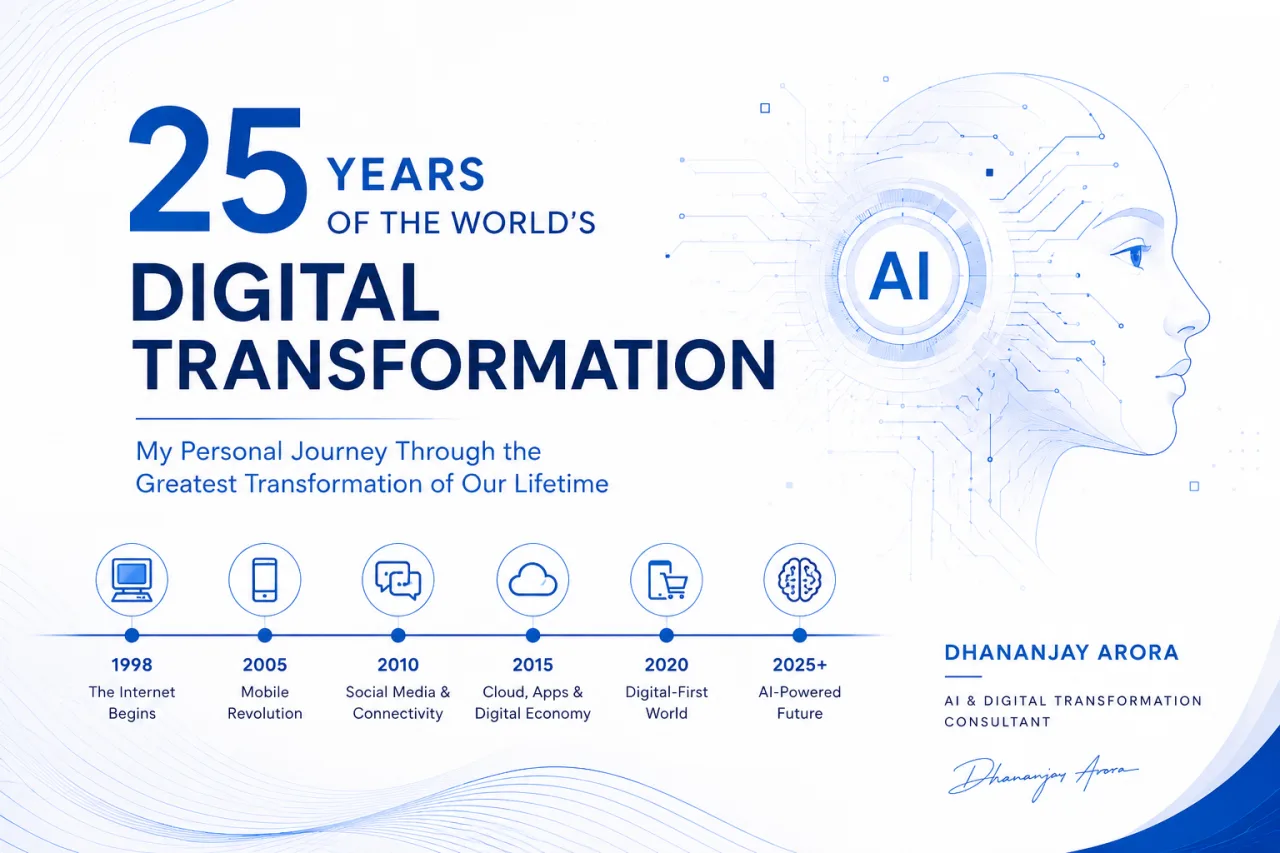
My Personal Journey Through the Greatest Transformation of Our Lifetime
In 1998, I started what was essentially a one-man digital agency. Today, in 2026, I lead a full-service digital agency with more than 100 team members across four countries.
I had no idea that over the next 25 years I would witness one of the greatest transformations in human history. But when I look back, what fascinates me most is not how businesses transformed. It is how the entire world transformed.
I have had a front-row seat to 25 years of digital evolution, and honestly, sometimes even I find it hard to believe how much has changed within a single generation.
When the Internet Was New
I still remember when the internet had just arrived in India.
Connecting to the internet was an event in itself.
You would dial in, wait patiently, hear strange modem sounds, and sometimes spend anywhere between 5 and 15 minutes just trying to get connected.
Today's generation streams 4K videos instantly. Back then, loading a single image could test your patience.
At that time, nobody imagined that the internet would eventually become the backbone of business, communication, entertainment, education, healthcare, and everyday life.
Yet here we are.
The Evolution of Hardware
I have seen computers evolve from bulky machines that needed an entire setup - CPU, monitor, keyboard, mouse and cables everywhere - you needed 2 people to lift a single computer to laptops that can practically be lifted with 2 fingers today!
Storage evolved from floppy disks to CDs, DVDs, external hard drives, cloud storage, and now virtually unlimited digital storage available on demand.
I have watched servers move from physical machines sitting in office server rooms to virtual environments and eventually to the cloud, where infrastructure can be provisioned globally within minutes.
Things that once required large investments, weeks of planning, and dedicated teams can now be deployed with a few clicks.
From Domains Taking Weeks to Websites Launching in Minutes
There was a time when registering a domain name could take days or even weeks.
Launching a website was a project.
Today, someone can conceptualize, build, and deploy a website in less than fifteen minutes.
The barriers to entry have collapsed.
Technology that was once available only to large corporations is now accessible to almost anyone with an internet connection.
Before Smartphones Changed Everything
One thing many people forget is that there was an internet before smartphones.
There was an internet before mobile apps.
There was an internet before social media.
We consumed the internet sitting in front of a desktop computer.
Then smartphones arrived.
Looking back, that's when everything really started to change.
The smartphone was not just another device.
It fundamentally changed human behavior.
For the first time, the internet was no longer a destination.
It became a constant companion.
I still remember when receiving email on a phone felt revolutionary.
Today, it feels impossible to imagine life without it.
The Rise of Mobile Apps
The smartphone era gave birth to the app economy.
Businesses no longer lived only on websites.
They now lived inside people's pockets.
From banking to shopping, travel to entertainment, food delivery to healthcare, mobile applications transformed the way consumers interacted with businesses.
Entire industries were redesigned around mobile-first experiences.
User expectations changed forever.
People wanted everything instantly.
And businesses had to adapt.
Communication Was Reinvented
I have watched communication evolve dramatically.
We moved from SMS and emails to proprietary messaging platforms like BlackBerry Messenger.
Then came mass messaging platforms such as WhatsApp, Telegram, and many others.
Today, billions of people communicate instantly across borders, languages, and time zones.
Something that once felt futuristic has become completely normal.
From Cassettes to Unlimited Music
One of the most fascinating transformations has been digital media.
I remember storing music on cassettes.
Then came CDs.
Entire shelves were dedicated to music collections.
Today, virtually every song ever created is available on demand from the cloud.
We moved from owning media to accessing media.
The same transformation happened across movies, television, books, and entertainment.
Access replaced ownership.
Social Media Changed Human Behaviour
Perhaps no technology has changed society more dramatically than social media.
Initially, the internet was primarily about information.
Then it became about interaction.
Suddenly, everyone had a voice.
Individuals became publishers.
Communities formed around interests rather than geography.
Businesses could communicate directly with customers.
Consumers could influence brands.
And brands had to become more human.
Social media did not simply create new marketing channels.
It also changed how people formed opinions, discovered brands, built communities, and in many cases even built careers.
It changed culture itself.
The Evolution of Content
I have watched content evolve through multiple generations.
First, the internet was dominated by text.
Then images became the preferred medium.
Today, video dominates attention.
Short-form videos, reels, long-form content, podcasts, livestreams, and interactive media have completely transformed how people consume information.
Attention spans changed.
Discovery mechanisms changed.
Marketing changed.
Storytelling changed.
The way humans learn and engage with information changed.
The Creator Economy Was Born
One of the most unexpected developments of the digital era has been the emergence of entirely new professions.
Twenty-five years ago, nobody aspired to become a content creator, influencer, YouTuber, podcaster, or digital educator.
These careers simply didn't exist when I started my journey.
Today, millions of people around the world have built businesses, brands, and careers entirely through content.
Digital technology didn't just create new tools.
It created entirely new economic opportunities.
Search, Discovery, and Information
I remember when Yahoo was one of the gateways to the internet.
Then Google arrived and completely transformed how information was discovered.
For nearly two decades, search became synonymous with Google.
Today, it feels like we are witnessing another major shift.
Artificial Intelligence is beginning to challenge traditional search behavior.
People are increasingly asking questions rather than searching for keywords.
And once again, the way humans access information is changing.
Technology Entered Everyday Life
Digital transformation eventually moved beyond screens.
It entered everyday life.
Companies like Amazon changed shopping.
Uber changed transportation.
Airbnb changed travel.
Quick-commerce platforms changed how we buy groceries and essentials.
Technology stopped being something we used occasionally.
It became embedded into our daily routines.
The digital world became the real world.
Then Came COVID
The COVID era accelerated digital transformation faster than anything I have ever witnessed.
Practices that might have taken years to become mainstream happened almost overnight.
Video meetings became normal.
Remote work became accepted.
Digital signatures became common.
Online collaboration became essential.
Companies, employees, governments, and consumers were forced to adapt.
What initially felt temporary became permanent.
COVID did not create digital transformation.
It accelerated it dramatically.
And Now, AI
If the internet was the defining technology of the last 25 years, I believe Artificial Intelligence will define the next 25.
For the first time since the internet became mainstream, I genuinely feel we are witnessing a technology that could be just as transformative.
The internet connected the world.
AI has the potential to fundamentally change how the world works.
AI is already changing how we search, learn, write, design, code, communicate, market, sell, and make decisions.
Soon it will become deeply embedded into every business process, every industry, and almost every profession.
- AI-powered systems.
- AI-powered businesses.
- AI-powered vehicles.
- AI-powered robots.
- AI-powered decision-making.
The next chapter has already begun.
And unlike many future predictions, this one is happening right now.
One Observation That Stays With Me
One thing I often tell younger entrepreneurs is that every generation thinks the biggest changes have already happened.
In reality, every generation gets its own wave of disruption.
For my generation, it was the internet.
For the next generation, it may very well be AI.
The opportunities often belong to those who spot the shift early and are willing to adapt before everyone else does.
What 25 Years of the World’s Digital Transformation Has Taught Me
After spending more than two decades in digital, a few lessons stand out -
Technology never stops changing.
The people and businesses that thrive are not necessarily the smartest or the biggest.
They are the ones that adapt fastest.
Learning is no longer optional.
It is a lifelong requirement.
The earlier you understand emerging trends, the earlier you see opportunities.
And in entrepreneurship, seeing opportunities before others can be a game-changer.
But there is another lesson that is equally important -
While technology changes constantly, human nature changes very little.
- People still seek trust.
- People still seek connection.
- People still seek belonging.
- People still seek community.
- Technology evolves.
- Human emotions remain remarkably consistent.
That is why even in an AI-driven future, people will continue to matter.
Looking Back and Looking Forward
Today, I work as an AI and Digital Transformation Consultant, helping businesses navigate the next wave of change.
But when I reflect on the last 25 years, what amazes me most is not the technology.
It is the scale of transformation that technology has enabled across humanity.
I have watched the world move from dial-up internet to AI.
From desktop computers to smartphones.
From websites to apps.
From search engines to intelligent assistants.
From physical infrastructure to cloud computing.
From information scarcity to information abundance.
If there is one thing these 25 years have taught me, it is that the future usually rewards those who keep learning, keep adapting, and remain curious.
Because the next transformation is always closer than we think.